Chumash Ancestral Lands: A USC Cinema & Meta Partnership
Developed within the USC School of Cinematic Arts VR Production program, this project was made possible through an extensive equipment grant and technical partnership with Meta, providing access to professional-grade 360° 3D cameras and cine-film equipment. The exhibit translates historical environmental data into a visceral journey, facilitating a powerful transition between pristine indigenous landscapes and modern-day industrialization.
Spatial Storytelling & Hardware-Driven Asset Pipeline
The core of the experience is built around a "Turn-to-Reveal" narrative mechanic. Using After Effects for high-end 360° compositing, I engineered a seamless environment where the guest begins in a pristine, pre-colonial Chumash landscape. Triggered by directional spatial audio, the user is prompted to turn 360° or 180°, revealing the stark, modern-day reality of the same location. This simple yet effective interaction creates a profound sense of loss and environmental change through immediate visual comparison.
Asset Pipeline & Photogrammetry
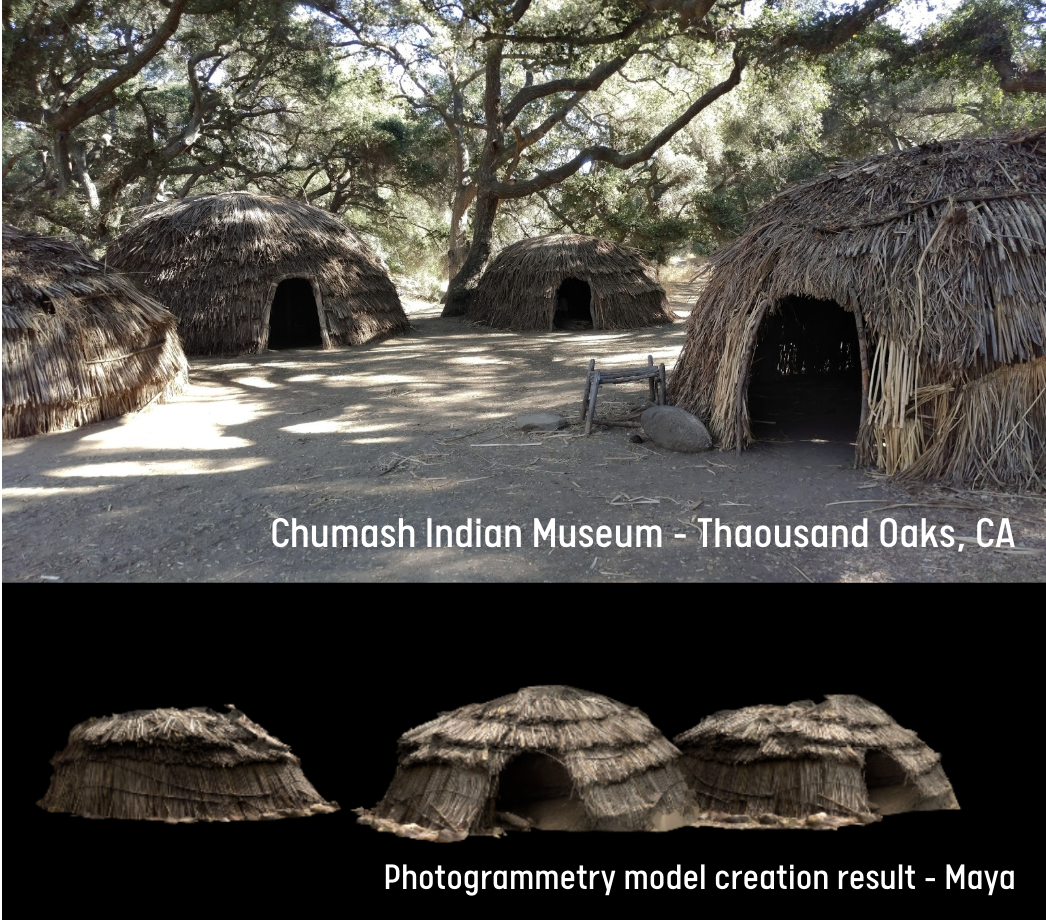
To ensure the historical accuracy of the indigenous scenes, I conducted on-site research at the Chumash Indian Museum.
3D Capture: Utilized Meta-donated 360° 3D cameras to capture the Santa Monica and Malibu coastlines with absolute spatial accuracy.
Modeling: Built high-fidelity photogrammetry models of Chumash dwellings and artifacts in Maya.
Compositing: Layered these historical assets into the captured 360° environments using After Effects, removing modern structures to restore the landscape to its original state.
Project Specifications
Partnership: USC School of Cinematic Arts & Meta.
Hardware Grant: Professional 360° 3D Cameras, Cine-Film Equipment, and Meta Quest Headsets.
Core Software: Adobe After Effects (360 Compositing) and Autodesk Maya (Photogrammetry & Modeling).Audio: Spatial environmental soundscapes.
Environmental World-Building & Narrative Impact
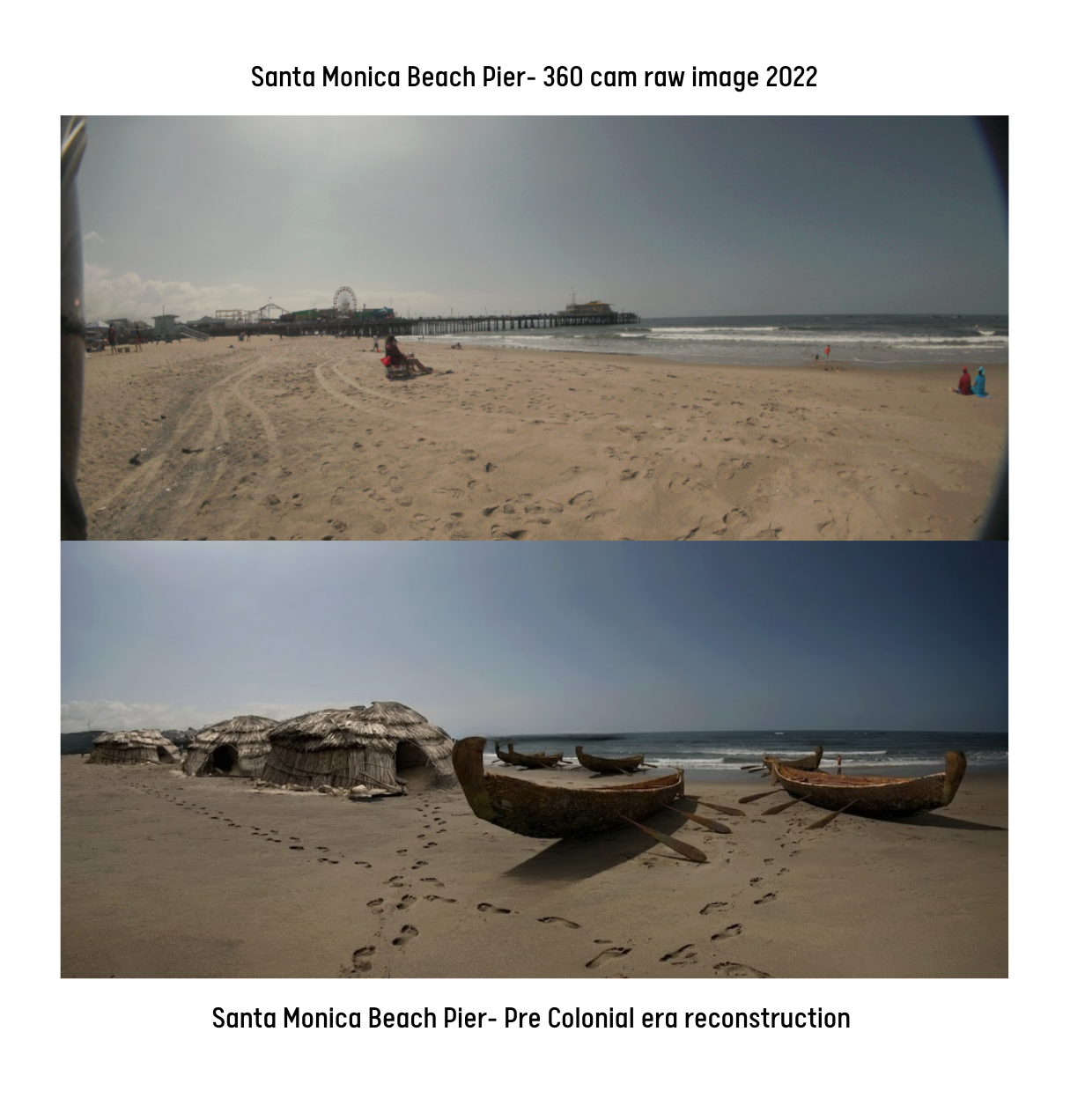
Utilizing a professional-grade 360° hardware grant from Meta, I captured the modern Santa Monica coastline as a baseline for environmental comparison. I then engineered a seamless historical reconstruction by removing modern infrastructure in After Effects and compositing photogrammetry-derived Chumash dwellings and tomols (plank canoes) modeled in Maya.
Beyond simple object removal, I digitally restored the ecological integrity of the landscape to heighten the contrast between eras. In the 18th-century reconstruction, I visually enhanced the air quality by removing modern smog and haze, restored the water clarity to its pre-industrial state, and textured the pristine sand to remove modern debris and heavy footprints. This attention to environmental detail, combined with the 'Turn-to-Reveal' mechanic, allows users to experience a visceral 300-year jump in time—fostering a deep, empathetic connection to the land's original, thriving state versus its current exploited condition.
Click here to learn more about the Chumash Tribal Group:
Chumash Museum- Thousand Oaks, CA
4D Systems Integration Plan (Concept)
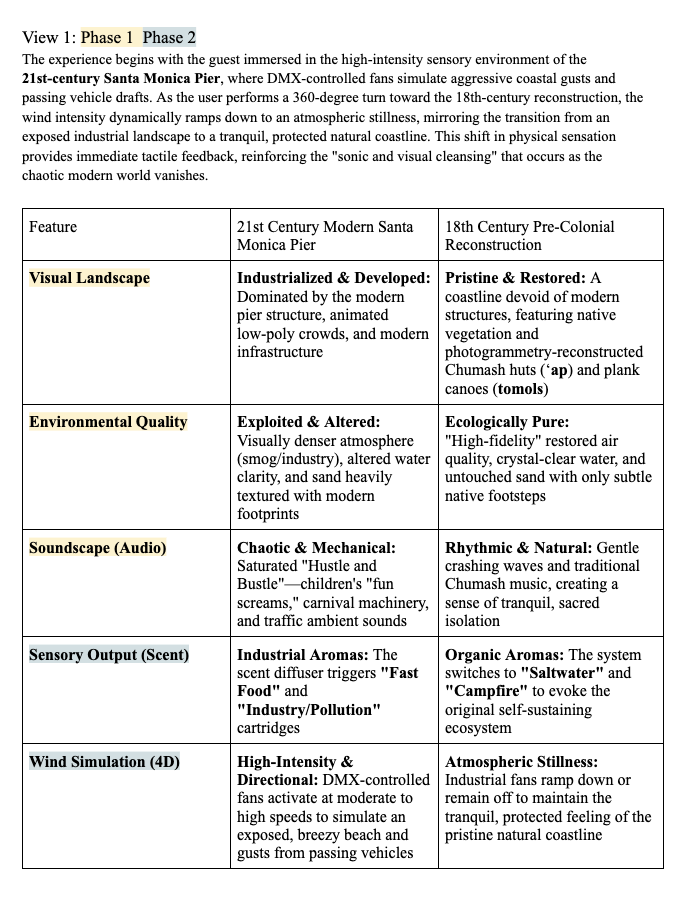
To further the impact of the installation, I developed a comprehensive technical plan to synchronize the visual transitions with physical environmental effects.
Scent Dispersion: A planned implementation using an ESP32-based REST API to trigger specific scent cartridges, such as "Saltwater" for historical scenes and "Industry/Pollution" for modern ones.
Dynamic Wind: A strategy for DMX-controlled fans that increase in intensity as the user turns toward the exposed, high-traffic modern pier.
Technical Pillars: Bridging History & Immersive Tech
Multi-Sensory 4D Systems Architecture: I am engineering a custom technical bridge between virtual environments and physical hardware. By integrating DMX-controlled fans and ESP32-based scent diffusers, I hope to create a visceral, tactile connection to the narrative, allowing environmental cues like wind and aroma to sync perfectly with the digital transition.
Advanced Spatial Storytelling: Utilizing spatial audio as a narrative compass, I directed user attention toward a "blind spot" trigger behind the guest. This proves the ability to manage guest focus and agency within unconstrained 360° environments by using sound to pull the user through a 300-year chronological jump.
High-Fidelity Asset Pipeline: Leveraging a Meta professional hardware grant for 360° spatial capture, I demonstrated "on-set" technical literacy. I utilized photogrammetry and Maya to reconstruct culturally and historically accurate 18th-century ’ap (dwellings) and tomols (canoes) based on museum research.
Environmental World-Building: My post-production workflow went beyond simple object removal. I performed a full ecological restoration in After Effects, digitally enhancing air and water quality and texturing pristine sand to highlight the profound environmental impact of colonization versus a self-sustaining ecosystem.